
.webp)

The Ducati 916, which appeared in 1994, is not just a motorcycle: it is a mechanical work of art that has changed the world of sports cars. Designed with passion and audacity, it combines the most refined Italian aesthetics and the technical requirements of a real racing machine. Even today, its heritage lives on and continues to inspire anyone looking for the perfect balance of beauty, performance and thrills on two wheels.
The Italian masterpiece that redefined sports
When it arrived in 1994, the Ducati 916 was part of a context where the sports category was largely dominated by Japanese manufacturers. Honda has just succeeded its legendary RC30 with the RC45 (with a 750cc V4 engine), Yamaha is lining up its YZF750, Kawasaki is continuing to refine its ZXR750, and Suzuki is upgrading its GSX-R 750. All these motorcycles share a technological philosophy focused on in-line or V-shaped four-cylinders, increasingly advanced electronics and the adoption of aluminum perimeter frames.
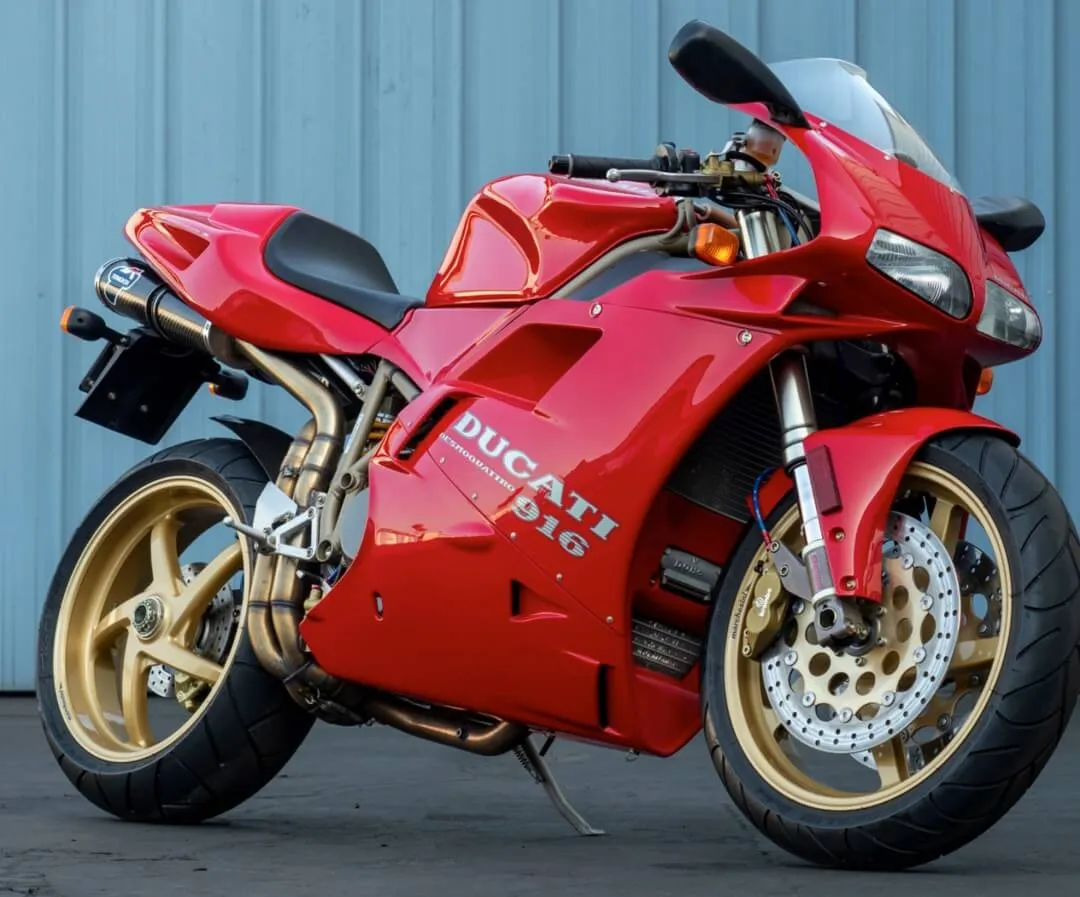
Ducati, for its part, chose to persist in the L-twin path, initiated by the 851 and 888, while entrusting the design of its new weapon to Massimo Tamburini, already famous for his work at Bimota. While the Japanese rely on peak power (often close to 120-130 hp for the SP or R versions) and the reliability of their engines, Ducati adopts another strategy: prioritizing mid-range torque, lightness and a radically innovative design. The result? A silhouette that stunned the public as soon as it was presented: fairing sides that closely fit the engine block, visible tubular frame, single-arm oscillating arm revealing the rear rim, and especially those pots under the seat that give off a short and racy rear end.
With the 916, Italy opposes the linear power of Japanese women with Latin charm and an almost artistic approach to high performance. For many, it is a revolution: the motorcycle is no longer just a speed tool, it is becoming a mechanical work of art, designed with the same care as a piece of high fashion.
credits: https://motorcyclesports.net
Why did the 916 become a legend
Despite its raw figures sometimes below those of its four-cylinder rivals (Honda RC45 or Kawasaki ZXR 750R can reach 125-130 hp in their sharpest versions), the 916 seduced by the vivacity of its Desmodromic twin-cylinder. Cooled by liquid and developing around 114 hp at 9000 rpm for 90 Nm at 7000 rpm, this 916 cm³ block offers torque available from mid-rpm, which makes relaunches much easier. Its Desmodromic distribution (4 valves per cylinder) and its double overhead camshaft (DOHC) operated by toothed belts preserve the sporty DNA dear to Ducati. Compared to some more powerful “on paper” machines, the 916 can even be more powerful on the circuit thanks to its dynamic behavior.
At the same time, the agility of the 916 on the track comes from its meticulously designed chassis. The tubular steel mesh frame, which is more compact than Japanese perimeter aluminum frames, gives it a particularly slim silhouette. The 43 mm Showa inverted fork (adjustable in compression and rebound, 127 mm of travel) and the Showa rear shock absorber on a progressive link (130 mm of travel) ensure shock absorption that is both firm and precise, essential for controlling mass transfers at high speed. The idea of providing the motorcycle with adjustable steering geometry (adjustable hunting angle from 24° to 25°, trail from 94 to 100 mm) was almost avant-garde at the time, allowing fine adjustments according to the preferences of the pilot or the route to be faced.
In the Superbike World Championship, the 916 will impose its law in various forms (916 SP, 955, SPS...), accumulating titles with Carl Fogarty or Troy Corser and regularly challenging the Honda RC45, Yamaha OW-01 and other Kawasaki. Japanese engines are often more powerful at high revs, but the traction and ease of throttle that the 916 has when exiting corners make a difference. The legend was then forged on the track, while in dealerships, the motorcycle attracted a clientele passionate about the idea of acquiring this “racing dream” in a form approved for the road.
Added to this is the Ducati philosophy, a mixture of passion, demand and artisanal refinement. The choice of a dry clutch (multi-plate) reinforces the sporty personality of the 916: the pilot must deal with this famous “metallic edge”, typical of Ducatis of this generation, which has become a symbol for the brand's purists; the L-twin delivers a hoarsely rumble; the tubular frame affirms its affiliation with racing prototypes. While other brands rely on “clinical” technology, the 916 remains faithful to the Italian soul, requiring genuine commitment and tolerance from the pilot for his uncompromising sporting temperament.

The timeless heritage of an exceptional sportswoman
If we talk about the 916 as a simple sports car, we would be missing the point: it is as much a design object as it is a competition machine. While Japanese sportswomen often aim for absolute technical efficiency (great but sometimes devoid of visual emotion), the 916 dares to use mobile sculpting. Designed like a purebred racer in its beautiful red dress, with its exhausts under the seat to free up the line, it reflects the image of a living motorcycle, whose frame and engine are almost like pieces of silverware.
Over the years, the 916 evolved in 996 then in 998, before giving way to the 999 (under the pen of Pierre Terblanche), then to the 1098, the 1198 and the Panigale. All these models will more or less repeat the philosophy inaugurated by the 916: combining high performance and aesthetics to give birth to unique motorcycles. His successes in Superbike boosted both the popularity of Ducati and that of the twin-cylinder. The oldest versions (916 SP, SPS, etc.) today reach high ratings on the collection market, and it is easy to understand why: in addition to its sporting track record, the 916 remains, for many, one of the most beautiful sports cars ever designed.
In the 1990s, she embodied the face-to-face between Japanese technical rigor and Italian artistic passion; and, in retrospect, it can be said that she succeeded in imposing her own standards. Even today, a simple look at its silhouette is enough to evoke the passion for racing, the smell of hot rubber and the magic of a motorcycle that dares to combine mechanical efficiency with the grace and sensuality characteristic of transalpine style.
Although today it remains the essential reference for anyone who wants to understand how a simple motorcycle, born in a small Italian factory, was able to sustainably revolutionize the design and conception of sports cars around the world, for many enthusiasts, riding a 916 is to experience the raw passion of another era, when motorcycling required more effort, attention, and rewarded the pilot with unique sensations.
In an era of electronic assistance and extreme performance, the 916 remains an open door to a certain mechanical romanticism, proving that beyond the search for chronology, beauty can be the noblest of victories.
