


The Honda CB750 not only revolutionized large displacement: it redefined the very concept of a modern motorcycle. When it appeared in 1969, this affordable four-cylinder engine offered front disc brakes, flawless reliability and performances previously reserved for an elite. Its global success shook the British old guard and opened the way for the reign of Japanese women on the road. More than just a model, the CB750 is becoming the symbol of a new era where technology meets passion.
The birth of the myth: Honda is shaking up the big engine
At the end of the 1960s, the global motorcycle landscape was dominated by British industry, with brands like Triumph, Norton or BSA, which offered twin-cylinder engines renowned for their torque and retro charm. However, a new wind is rising from Japan. Honda, already essential on small and medium-sized engines thanks to its reliability and technological mastery, decided to strike hard in 1969: the birth of the Honda CB750 was born. With its in-line four-cylinder engine and front disc brake, it is preparing to redefine the standards of heavy-duty motorcycles for decades to come.
To understand the impact of the CB750 as soon as it was launched, you have to put yourself in the context of the time. Riders are always looking for more performance, but also reliability and convenience on a daily basis. Japanese manufacturers, who first conquered the market with small economical motorcycles, are now increasing their engine capacity. Building on its success in competition (especially in Grand Prix races), Honda is developing a series engine derived from its racing expertise: a transversal 4-cylinder engine, cooled by air, with a displacement of approximately 736 cm³ and developing nearly 67 hp. A respectable figure for the year 1969, especially when combined with operational flexibility and ease of use unprecedented in the category.
But the real revolution is not limited to the block. The Honda CB750 is in fact one of the first production motorcycles to be equipped with a front disc brake, which is a major advance in terms of safety and braking. While many competitors keep front drum brakes, which are less durable, the CB750 offers riders more precise control, while reinforcing its image as a “modern” machine. Its lines, too, break with purely British tradition: the tank is more angular in shape, the rear-view mirror is integrated into the handlebars, the dashboard houses two clearly legible round counters, and of course we find these four chrome exhaust pipes that meet into two silencers on each side (in the so-called “four pipes” version).
Quickly, fans of large engine motorcycles are seduced. In the United States, the CB750 embodies the promise of a road animal capable of swallowing kilometers on the highway while being docile in the city. In Europe, it is a technical UFO: can we really offer a powerful, reliable four-cylinder engine at a competitive price? Honda succeeds, almost in a few years, overturning a market where the British were already beginning to show signs of fatigue. Specialized magazines praise the CB750, considering it to be a major turning point in the evolution of production motorcycles. Its general balance, its technological standing and its relatively accessible price made it an object of desire for motorcyclists of the time, eager for new things.
Why is the CB750 the first “superbike”
Multiple models have taken advantage of significant innovations or performances, but the 1969 Honda CB750 truly made history through three fundamental aspects: the mechanical revolution, cultural impact, and a design that was both daring and simple.
First, there is the mechanical revolution. The transverse four-cylinder already existed in competition, but it was rare to find it on a mainstream machine. With the CB750, Honda is making this engine layout accessible to a wide range of customers. The result is impressive: more than 200 km/h at the top, linear acceleration and great flexibility thanks to quadruple carburetor. From the start, the softness of the four cylinders seduces. No more excessive vibrations specific to big English speakers, make way for smoother operation and greater overall reliability. The front disc brake is another key point, giving the CB750 a considerable advantage in terms of safety at the time.
Second, the cultural impact is immediate. The CB750 is often described as the first mass-produced “superbike”. It is not only a question of numbers, it is also a question of status: on the road, the presence of its four pots and its brilliant engine arouse fascination and curiosity. Amateur drivers, seeing this as a machine with sporting potential, do not hesitate to take part in local competitions or to participate in endurance races with lightly prepared versions. Several personalities, especially in the United States, adopt the CB750 as a symbol of modernity. At the same time, it is becoming a support for customization: the “chopper” or “café racer” trend is taking hold of it, and we are seeing all sorts of variations flourish, from homemade bobbers to minimalist cafe-racer preparations. As such, the CB750 becomes a “universal” model, an ideal base for any project.
Finally, the design is both simple and striking. If we compare the 1969 CB750 to some competitors of the time, we see a more “geometric” approach: a rectangular tank with soft edges, triangular side covers, and of course this double exhaust line with four outlets. The bike is large, but not excessive, and the bike part is quite simple: a tubular steel frame, a telescopic fork at the front and two combined shock absorbers at the rear. The ergonomics are designed for mixed use: duo comfort, luggage possible, and relaxed driving position, which makes it more versatile than a purely sporty machine. This versatility, combined with its “no nonsense” look, makes it timeless. Even today, many cooks and restaurateurs are inspired by its lines, often preferring a refined version to accentuate the beauty of their 4-cylinder engine.
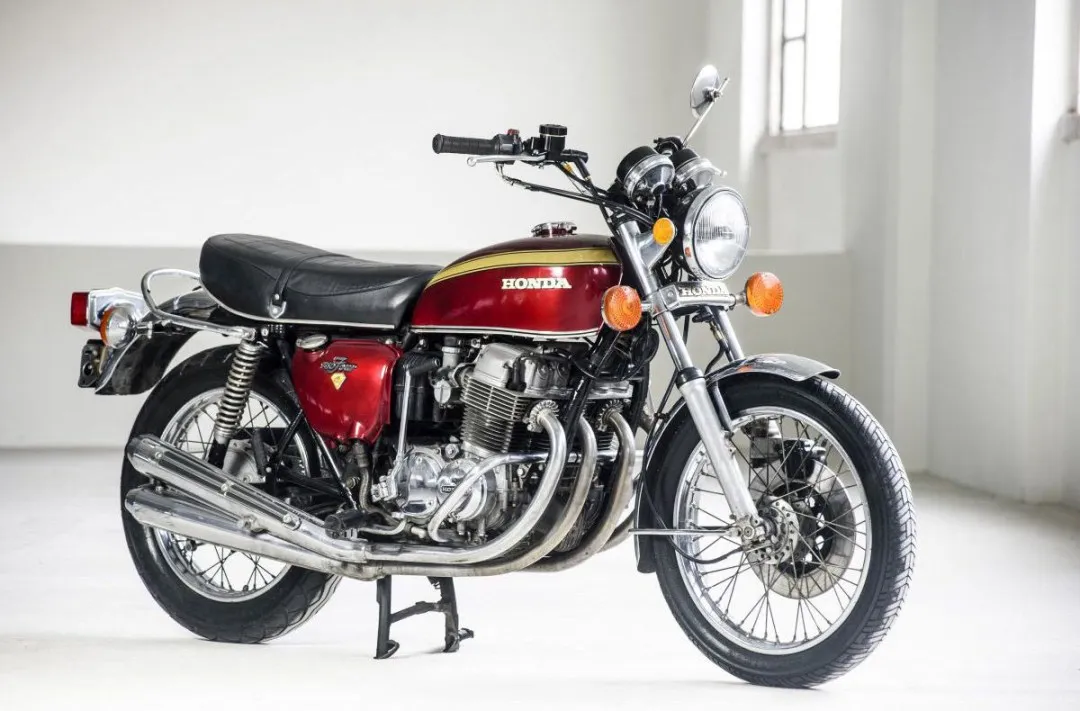
The timeless heritage of a four-cylinder revolution
It's impossible to talk about the CB750 without talking about the gigantic influence it had on the motorcycle industry. By launching this “4-legged” that was considered daring at the time, Honda began a new era. Very quickly, Kawasaki reacted by launching its 900 Z1 (then the 1000 Z1-R), Yamaha developed its own 4-cylinder XS, and Suzuki followed suit with the GS. The era of the “big British sisters” was already in decline, and the CB750 accelerated this transition: Japanese reliability, competitive price and comfort outweighed the slightly aging charm of English brands. Gradually, the revolution began, and the expression “Universal Japanese Motorcycle” (UJM) was born to refer to these “all-purpose” motorcycles that use the same mechanical framework: 4-cylinder in-line, double rear shock absorbers and a functional design.
On the cultural level, the CB750 emerged in the 1970s as the motorcycle of “Mr. Everyone” who wanted to offer a touch of sportiness, but also comfort on a daily basis. It also serves as a basis for extravagant preparations: the legendary choppers developed in the United States, with their “ape hanger” handlebars and extended forks, frequently use the CB750 engine, which is considered more reliable than American V-twins for long routes. In Europe, it gives rise to café-racer variants: we shorten the rear buckle, we install wristbands, and we try to imitate the look of racing bikes. In all these configurations, the CB750 shines by its adaptability and robustness.
As for its sports track record, the CB750 contributes to the democratization of competition for amateurs. In endurance races, some private teams dare to use this machine, thus proving that a mainstream motorcycle can handle hours of racing without fail. While the CB750 did not always dominate the racing scene compared to more specialized motorcycles, it is nonetheless emblematic of a time when you could almost “buy the Sunday bike at the corner store” to make it a race frame at the weekend.
From an industrial point of view, the CB750 is a milestone: it is it that definitively propels Honda to the rank of major manufacturer of large engines. Subsequent generations (CB750 K1, K2, K6, etc.) will refine the recipe, with improvements in brakes, suspension or finish. Later, other models in the Honda range (CB900F, CBX1000...) would perpetuate this spirit of reasonable performance, while innovating regularly. Japanese competition, inspired by the success of the CB750, also developed its 4-cylinder ranges, which led to the triumph of Japanese motorcycles on the global market in the 1970s and 1980s.
Finally, the community around the CB750 continues. Clubs dedicated to the “Seven-Fifty” exist on all continents. Collectors are in particular looking for the first series, sometimes called “Sandcast” (whose crankcases were produced by sand casting), which became extremely rare and highly valued. The CB750 restorations highlight how ahead of the curve this bike was for its time and how relevant its design remains today, more than fifty years after its release.
In short, the 1969 Honda CB750 is one of the most influential motorcycles in history. It embodies at the same time a mechanical revolution, a cultural icon and an industrial turning point that tipped the motorcycle world towards the Japanese four-cylinder era. Its commercial success, its reliability, its potential for personalization and its relative accessibility have forged its legend, arousing the admiration of several generations of motorcyclists. For many, it remains the “mother of all superbikes” and continues to thrill those who dream of a singing four-legged friend on small country roads, or a retro-chic silhouette pacing the city in style and confidence.
