
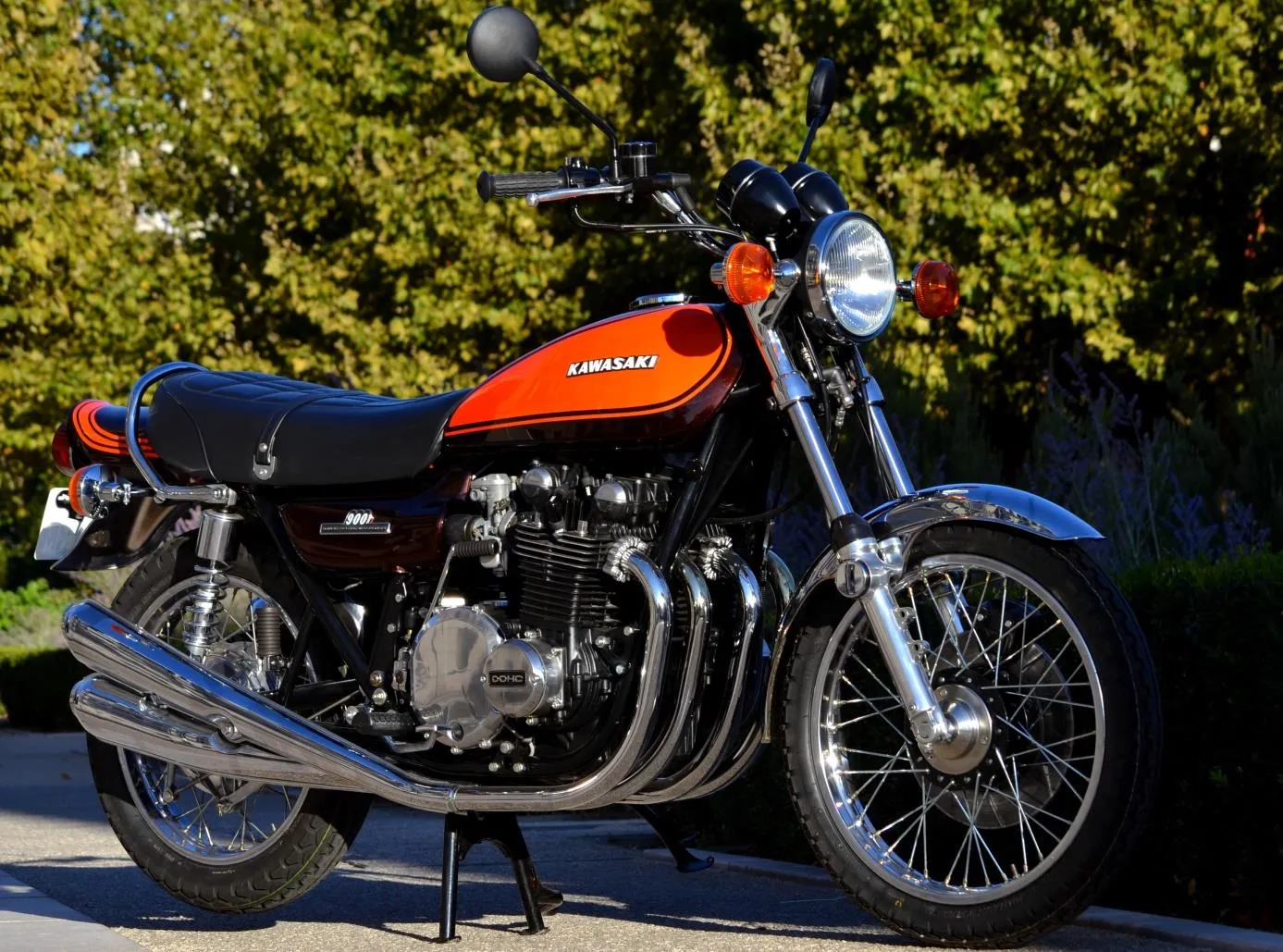
In 1972, Kawasaki hit a big blow by launching the Z1: a 903cc four-cylinder engine that aimed to surpass anything else in terms of power and speed. With its raucous sound, its imposing appearance and its legendary robustness, the Z1 immediately established itself as a “superbike” before its time. A look back at one of the most striking motorcycles in Japanese history.
Spectacular performances that marked the seventies
When the Kawasaki Z1 appeared in 1972, the large-capacity market was already changing. Honda hit hard by launching its CB750 at the end of the 1960s, seducing motorcyclists with its reliable and accessible four-cylinder engine. Meanwhile, British brands such as Triumph or Norton are struggling to reinvent themselves, while other Japanese firms (Suzuki, Yamaha) are developing their own models to meet the growing appetite of fans of “big cubes”. In this turbulent context, Kawasaki decided to strike even harder: to produce the most powerful and fastest production motorcycle of the moment, shaking up established references.
The recipe adopted by Kawasaki is based on a double ambition: on the one hand, an exceptional engine — a 903 cm³ four-cylinder in-line, air-cooled, with double overhead camshaft (DOHC) and two valves per cylinder — and on the other hand, a robust cycle part to handle this additional performance. The double tubular steel frame recalls the heritage of the brand's sports cars, while the “straight cut gears” technology on the primary transmission testifies to the desire to obtain a block that is as resistant as it is responsive. With a compression ratio of 8. 5:1, the Z1 boasted nearly 82 hp at 8500 rpm, a sensational figure for the time, and a generous 73.5 Nm of torque at 7000 rpm.
However, this new flagship of Kawasaki does not forget the practical aspects: an electric starter is combined with a kick starter for fans, and the 18-liter tank offers a decent range, especially since a consumption of 4.9 L/100 km is relatively controlled for a machine of more than 900 cm³. Its design, marked by a large reservoir, a comfortable seat perched at 812.8 mm and an 818 mm wide handlebar, aims to seduce both lovers of long rides and performance enthusiasts. As soon as it was released, the Z1 was thus a real superbike before its time, ready to dethrone the Honda reference and write a new page in the history of large engines.

Why did the Z1 become a legend
The Kawasaki Z1 quickly established itself as a thrill machine, loved by riders looking for raw performance. The numbers don't lie: a 0 to 96 km/h shot down in just 4.8 seconds, a 0 to 50 km/h in 2.7 seconds, and a 400 m from a standing start in 12.61 s at around 170 km/h. Thanks to its 4 Mikuni VM28SC carburetors, the engine responds with passion to the slightest solicitation of the gas handle, and the hoarling sound of the 4-in-1 exhaust (on the first series) accentuates the impression of irrepressible power.
Compared to Honda CB750, already considered to be the queen of the road, the Z1 clearly exceeds 750 cm³ to peak at 903 cm³, thus displaying greater power and a top speed of around 217 km/h. Its larger tubular double cradle frame can support the additional weight — 230 kg dry, 247.6 kg fully loaded — and contributes to correct stability in a straight line, an essential condition for exploiting its potential. Admittedly, the braking is not yet up to the ultimate performance: the front wheel only receives a single 296 mm disc, pinched by a 2-piston caliper, while the rear wheel is content with a 200 mm drum. At the time, however, it was common equipment, and the competition was not much better equipped.
Beyond its flattering statistics, the Z1 seduces by its versatility. Its driving position remains relatively comfortable: the seat at more than 80 cm from the ground and the wide handlebars promote a relaxed posture, both for the city and for the road. The engine block, which accepts lower revs without hesitation, knows how to be docile in city traffic, before metamorphosing into a roar as soon as it is asked to accelerate frankly. This duality, between the passion of competition and the accessibility of everyday life, forges the image of a motorcycle that can do everything, as long as you dare to turn the handle all the way.
The timeless heritage of a motorcycle that has become an icon
For Kawasaki, the Z1 represents a major strategic turning point. It quickly became a symbol of Japanese power in the field of large engines, in the same way as the CB750 for Honda. Its commercial success pushes the green brand to develop a whole line of “Z” motorcycles (Z900, Z1000, etc.), perpetuating this spirit of large torque blocks and solid cycle parts. On the European and North American markets, the Z1 quickly established itself as the most muscular alternative to competing machines, showing that a manufacturer could combine reliability, accessibility and record performances.
Over the decades, the Z1 has become a highly sought-after collector's item. Its typical “seventies” aesthetic — tapered tank, rounded lines, analog dials — evokes real nostalgia among motorcyclists who grew up with the dream of owning a “Japanese 900cc”. Cafe-racer or street bike preparations based on the Z1 underline its potential for personalization, while purists strive to keep their copy as close as possible to the original. Whether restored faithfully or enhanced through modifications, the Z1 maintains that raw charm that thrilled an entire generation.
Today, in an age of motorcycles packed with electronics and capable of excessive performance, the 1972 Kawasaki Z1 seems like a gentle reminder of a simpler but no less exciting era, where engine capacity and the sensation of pure power were sought above all. In a sense, it paved the way for modern sports cars and laid the groundwork for a philosophy of “always more”, so appreciated by fans of large engines. More than fifty years after its release, the Z1 continues to fascinate: one can only imagine the effect it produced in 1972, when it overshadowed everything in its path thanks to its roar and its imposing appearance. A true milestone in motorcycling history, the Z1 is and will remain that masterpiece that redefined what a “big” motorcycle was.
