

The British spirit on two wheels
When it comes to motorcycle history, few models embody the essence of British craftsmanship as well as the Triumph Bonneville. Presented to the public in 1959, it takes its name from a mythical place: the salt lake of Bonneville, in Utah, in the United States. A choice that is not trivial, since the Triumph brand, and more particularly its pilot Johnny Allen, had broken speed records there on a specially prepared motorcycle. At the heart of this new Triumph Bonneville, called “production”, we find a 650 cm³ parallel twin cylinder which, from the start, set the standard in terms of style, performance and agility.
To understand why this motorcycle quickly conquered British, European and even American roads, it is necessary to look at the context of the end of the 1950s. The post-war period marked the revival of many industries, and the motorcycle industry was no exception to this momentum. British manufacturers, with brands such as Norton, BSA and of course Triumph, are competing to offer models capable of attracting customers eager for speed, but also for reliability and aesthetics. In this context, Triumph, whose reputation had already been built since the beginning of the 20th century, decided to strike a major blow by launching the Bonneville, an improved version of the existing Tiger T110, in particular by integrating dual carburetor.
The birth of the 650 cm³ parallel twin cylinder was intended to be a direct response to the growing demand for more powerful machines. While the Tiger T110 already had a reputation for being fast, the Bonneville, equipped with an Amal dual carburettor, pushes the possibilities even further. The idea of using the name “Bonneville” is a strong marketing choice, but also a way to highlight the link between the production bike and the machine that set records on salt lakes. Thus, it plays on the fantasy of speed and adventure, while paying tribute to the culture of the pioneers of “speed”.
Beyond pure performance, the British spirit is also reflected in the elegance and simplicity of the Bonneville. Its design, clean and without unnecessary frills, is in line with the Triumph tradition. We find a tubular steel frame, a softly curved tank, well-proportioned mudguards and a round headlight. The chrome finishes highlight the lines, without ever giving the impression of a decorative surplus. The colors offered (often two-tone) highlight the silhouette of the bike, further reinforcing this feeling of visual balance.
This balance is also found on the handlebars. While the 1959 Bonneville did not revolutionize the driving position per se, it did offer considerable comfort for the time. The seat, which is wide enough, allows longer trips without too much fatigue, while the weight distribution is designed to optimize maneuverability. Compared to some heavy and less agile competitors, the Bonneville is distinguished by its relative lightness and a chassis that provides an immediate sense of control. It is precisely this ease of driving, combined with the “potato” of the twin-cylinder, that gives it an incomparable appeal for those looking for both driving pleasure and everyday practicality.
In England, the end of the 1950s and the beginning of the 1960s also correspond to a period of cultural turmoil. The rock'n'roll movement is in full swing, youth are emancipating and looking for new ways of expression. In this context, the motorcycle becomes a symbol of freedom, speed and, to some extent, quiet rebellion. The Triumph Bonneville, with its dynamic aura, quickly conquers young and old thrill seekers. On country roads, on the edge of cities like London, Birmingham or Manchester, we come across these nerve-looking motorcycles more and more often. Cafe-racers and motorcycle clubs adopt the Bonneville as the frame of choice for their trips.
This enthusiasm is not limited to the United Kingdom. The United States, seduced by the exoticism of European motorcycles, is also beginning to import it. American roads, which are longer and straighter, lend themselves well to showcasing the Bonneville's speed and torque. Its reputation for reliability — compared to other exotic machines of the time — makes it even more appealing. Triumph dealerships across the Atlantic highlight its budding legend, adding to the machine the aura of British culture: elegance, class, but also a certain adventurous and rebellious side.
This fusion between performance, aesthetics and a spirit of independence summarizes all the DNA of the Triumph Bonneville. Its simple name already evokes a desire for speed, wide open spaces and records. While other English manufacturers have produced equally remarkable motorcycles, few have had such a cultural impact over the decades. The 1959 Bonneville was quickly perceived as an object of desire for an entire generation, one that wanted to drive fast and free, in style, but without necessarily looking to spend a fortune.
In short, the British spirit that inhabits the Triumph Bonneville is not limited to a simple assembly of mechanical parts. It encompasses a whole imaginary world, that of an England proud of its know-how, of a nation that is a pioneer in motorcycling, and yet looks beyond its borders for inspiration. Named after the records broken on an American salt lake, Bonneville symbolizes the bridge between English tradition and adventure on the great American expanses. This subtle balance between local identity and the dream of escape is an integral part of the success of Bonneville, and that is precisely what still makes it an iconic motorcycle today.
Why is it legendary

Many motorcycles of the time claimed more or less exceptional performance or innovative design, so what made the Triumph Bonneville a truly legendary model? The answer lies in three fundamental aspects: performances that have made an impression, a cultural influence that goes beyond the simple framework of mechanical enthusiasts, and a timeless design that is always copied but never really equalled.
The first point to highlight is, of course, performance. At the end of the 1950s, the Bonneville T120 was one of the fastest production motorcycles on the market, capable of easily exceeding 100 miles per hour (around 160 km/h), which, for the time, was simply impressive. This top speed, combined with strong acceleration, is precisely the answer to the enthusiasm of motorcyclists for raw power. Riders looking to push their machine to its limits particularly appreciate the “Bonnie”: the generous torque, the flexibility of the twin-cylinder and the relative lightness of the bike combine to offer new sensations. Lovers of highway runs or small winding roads will also find something for themselves, thanks to a well-balanced chassis and precise steering (for the standards of the time).
This performance echoes the symbolic relationship with Lake Bonneville, the scene of speed records. Admittedly, the production motorcycle does not have much to do technically with the “streamliner” driven by Johnny Allen, but the very name “Bonneville” inevitably evokes the idea of pushing the limits. Owning a Bonneville means being associated with the image of surpassing oneself, of the quest for records. This reputation grew stronger as the T120 garnered praise from the specialized press and achieved a few achievements in track and flat track competition.
The second aspect that anchors Bonneville in legend is the considerable cultural influence it has exerted. Countless iconic personalities have been seduced by its charm. Among the most famous is Steve McQueen, the iconic Californian actor and pilot, who perfectly embodies the cool and adventurous spirit of the 1960s. In his movies, as in his life, McQueen loves the Triumph Bonneville. His enthusiasm is shared by many music and movie stars, Bob Dylan being another striking example. This influence among celebrities has a direct impact on the collective imagination: the Bonneville then becomes not only a high-performance motorcycle, but also a stylish accessory, a symbol of freedom and self-assertiveness.
This aura extends throughout the English speaking world and beyond. In the United States, Bonneville benefits from the “British Invasion” effect, a term often used to describe the wave of British rock bands (such as the Beatles or the Rolling Stones) that conquered the New World in the early 1960s. In garages and cafes, young people dream of escapism and originality, of standing out from the norm. The Triumph Bonneville is therefore the ideal frame to embody this mixture of modernity, eccentricity and nostalgia for traditional England.
The third key element is the timeless design of the Bonneville. Its simple and elegant lines transcend fashion. Where other motorcycles of the time sometimes had overloaded designs, the Bonneville favoured simplicity: a tank curved enough to be recognizable at first glance, a refined frame, a comfortable but not excessive seat, and above all this apparent, almost sculptural parallel twin-cylinder engine, and above all this apparent, almost sculptural parallel twin-cylinder engine that contributes to overall harmony. The two-tone colors and the touches of chrome confer a resolutely vintage charm, which remains an object of desire today. Successive generations of Bonneville gradually modernized the lines and mechanics, but the basic structure remained generally the same, as the first version in 1959 was aesthetically successful.
Why is this design so popular? Probably because it reflects the idea of an accessible, human, modest-sized motorcycle that can easily be mastered and customized. Unlike some very large American engines, the Bonneville maintains a more “European” dimension, both in terms of its proportions and in its overall appearance. It seems less intimidating, more manageable on a daily basis, while conveying an undeniable charm. It is a perfect balance between sportiness, elegance and pragmatism.
Finally, its success helped to promote the British motorcycle industry, which then dominated a large part of the world market in the 1960s. The Bonneville, alongside models like the Norton Commando or the BSA Gold Star, carries the colors of Great Britain high on two wheels. Export sales are soaring, especially to the United States, which is a major consumer of characterful motorcycles. For a decade, Triumph was at the height of its glory. Fans of café racers, local competitions and long walks on British country roads are massively adopting the Bonneville. Every mention in a movie, every appearance in a magazine, every celebrity that rides her reinforces her iconic status a bit more.
In short, the legend of the Triumph Bonneville was forged thanks to this skilful blend of first-class performance, a strong cultural impact via icons of the time, and a design that was as simple as it was attractive. But the story does not end there, because Bonneville is not just a phenomenon of the 1960s. Over the decades, Triumph has been able to evolve this model while maintaining the essence that made it initially successful. Proof of this is: even today, more than half a century after its first version, the Bonneville continues to be produced in a modernized form, thus ensuring the sustainability of this myth on two wheels.
The legacy left by the Triumph Bonneville
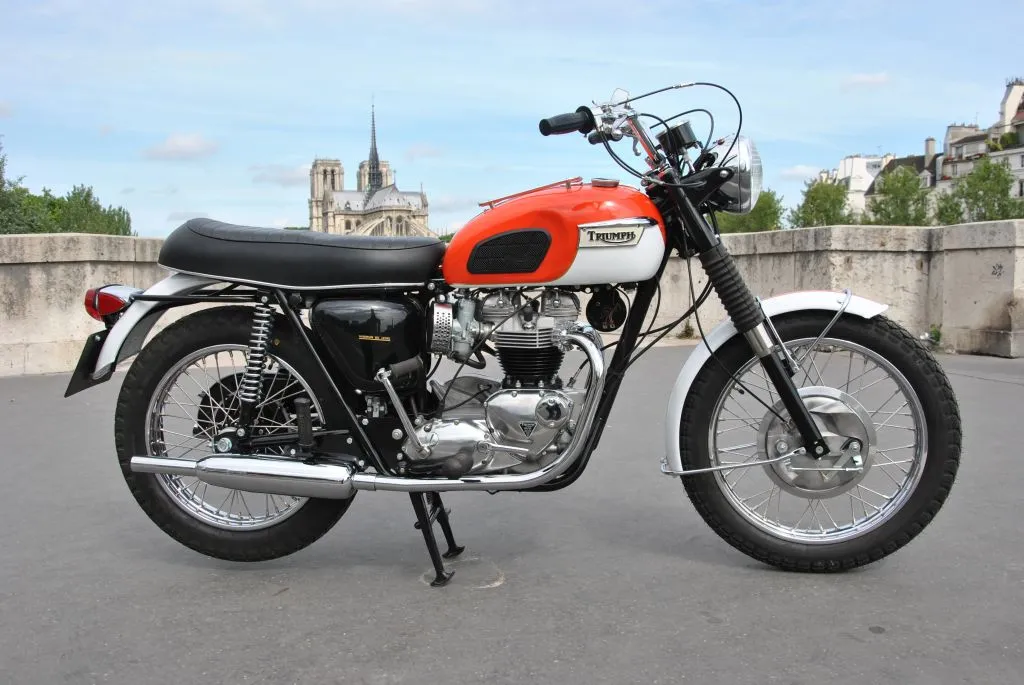
To talk about the heritage of the Triumph Bonneville is to talk about the considerable impact it has had, and continues to have, on the motorcycle world. At the time of its launch in 1959, no one suspected the extent of its future influence. However, more than sixty years later, the Bonneville still thrills motorcyclists around the world, whether collectors looking for vintage models, fans of café racer preparations, or even future owners seduced by the contemporary version.
The first step in this heritage is at the industrial and economic levels. In the 1960s, thanks to the success of the Bonneville, Triumph rose to the top of British manufacturers. The model became the figurehead of the brand, the one that brought the Meriden-based firm (and then other sites) onto the global motorcycle map. However, Japanese competition emerged at the end of the 1960s and, very quickly, Honda, Yamaha, Suzuki and Kawasaki began to rise in power. Japanese sports cars, in particular the Honda CB750 released in 1969, are shaking up the standards of quality, reliability and performance. This is creating a profound crisis for the British motorcycle industry, which is struggling to adapt to these new challenges.
Despite this difficult context, the Bonneville remained one of the pillars of the brand until the 1980s. When in 1983, Triumph was declared bankrupt and production stopped temporarily, one might think that the Bonneville legend was going to end. And yet, the story is not over. John Bloor, an English entrepreneur, bought the rights to the brand and relaunched it in the early 1990s. While he put classic models aside for a while to focus on more modern bikes, the idea of resurrecting the Bonneville never died out. In the hearts of motorcyclists, this name remains synonymous with prestige and authenticity.
It was finally in the year 2000 that Triumph reintroduced the Bonneville, in a neo-retro form, respecting the original aesthetics while integrating the necessary technological advances: more efficient disc brakes, electronic injection, increased reliability, etc. This revival was an immediate success. Classic motorcycle enthusiasts applaud the fidelity to design, while those looking for a machine suited to the modern road appreciate the added handling and safety. The resurgence of Bonneville is part of the wider vintage and retro trend, which appeals to a varied audience, from thirtysomethings in search of style to nostalgic sexagenarians.
Thus, the heritage of Bonneville also extends to the cultural level. Its mythical lines, its round headlight, its discreet chrome, its curved tank remain the reference for anyone who wants to build or customize a classic motorcycle. Preparers specializing in café racers and scramblers have long taken advantage of this technical base to create unique machines, combining modern components and the old-fashioned charm of the sixties aesthetics. Some opt for conversion kits that transform the Bonneville into a real retro racer; others prefer a more minimalist look, featuring the twin-cylinder engine and raw finishes.
Beyond even Triumph, other manufacturers are inspired by the Bonneville style for their neo-retro range. Ducati, Moto Guzzi, Yamaha, Kawasaki and Royal Enfield, to name but a few, now offer models with classic lines, responding to this persistent demand for motorcycles that combine modern technology and vintage charm. This “retro wave” owes a lot to Bonneville, which is, in a way, the emblematic initiator. It proves that a motorcycle does not have to have a futuristic look to find its place on the market. On the contrary, authenticity and homage to the past can prove to be major assets in attracting enthusiasts.
In terms of competition, the Bonneville has certainly lost its luster over the years in the face of cutting-edge sports bikes. But it is still illustrated in certain flat track events or vintage races, where revised or prepared models demonstrate that you should never bury a legendary name too quickly. Vintage motorcycle gatherings, such as the “Goodwood Revival” in England, regularly devote pride of place to Bonneville, a symbol of an era when metal and gasoline combined to create machines with character.
Another essential part of Bonneville's heritage lies in its impact on the motorcycle community. Numerous Triumph clubs exist around the world, bringing together enthusiasts from all walks of life. They organize walks, exhibitions, restoration workshops, thus keeping the fire going. These clubs embody a spirit of camaraderie, shared knowledge and shared passion. The Bonneville is often the common denominator, the motorcycle that brings generations together in the same enthusiasm. It is not uncommon to see a father and his son tinker together an old T120, or groups of friends crisscross the roads through the English, French or American countryside riding their flamboyant Bonnevilles.
Finally, and this is perhaps the greatest tribute that can be paid to this machine, the modern Bonneville has not stopped evolving. Triumph now offers several variants (T100, T120, Street Twin, Street Twin, Bobber, Speed Twin, etc.), each with its own personality, but maintaining the look and spirit dear to the brand. Thanks to on-board electronics, new materials and anti-pollution regulations, these versions offer a much more refined driving experience, while continuing the tradition. Thus, the Bonneville serves as a link between past and present, satisfying those looking for vintage charm as well as contemporary reliability.
In conclusion, the heritage of the Triumph Bonneville is at once industrial, cultural and emotional. It helped shape the golden age of the British motorcycle industry, became the icon of an entire generation of artists and rebels, and continues to inspire dreams today thanks to its many facets. Few motorcycles, more than half a century after their creation, maintain such an aura. By adapting to the times and maintaining its soul, Bonneville perfectly illustrates the possibility of reconciling tradition and innovation. And as long as there are enthusiasts to restore the old ones, fans to drive on the new ones, and dreamers to admire its timeless lines, we can safely bet that the legend of the Triumph Bonneville will continue to be written for a long time to come.
